
| Authors | NOBEL EDITORIAL BOARD |
| ISBN-13 | N/A |
| Publisher | R. Narain & Co. |
| Page Count | 500 Pages |
| Product Type | Hard Copy |
| E-Book | N/A |
Syllabus - MBA 3rd Sem. - HR Group
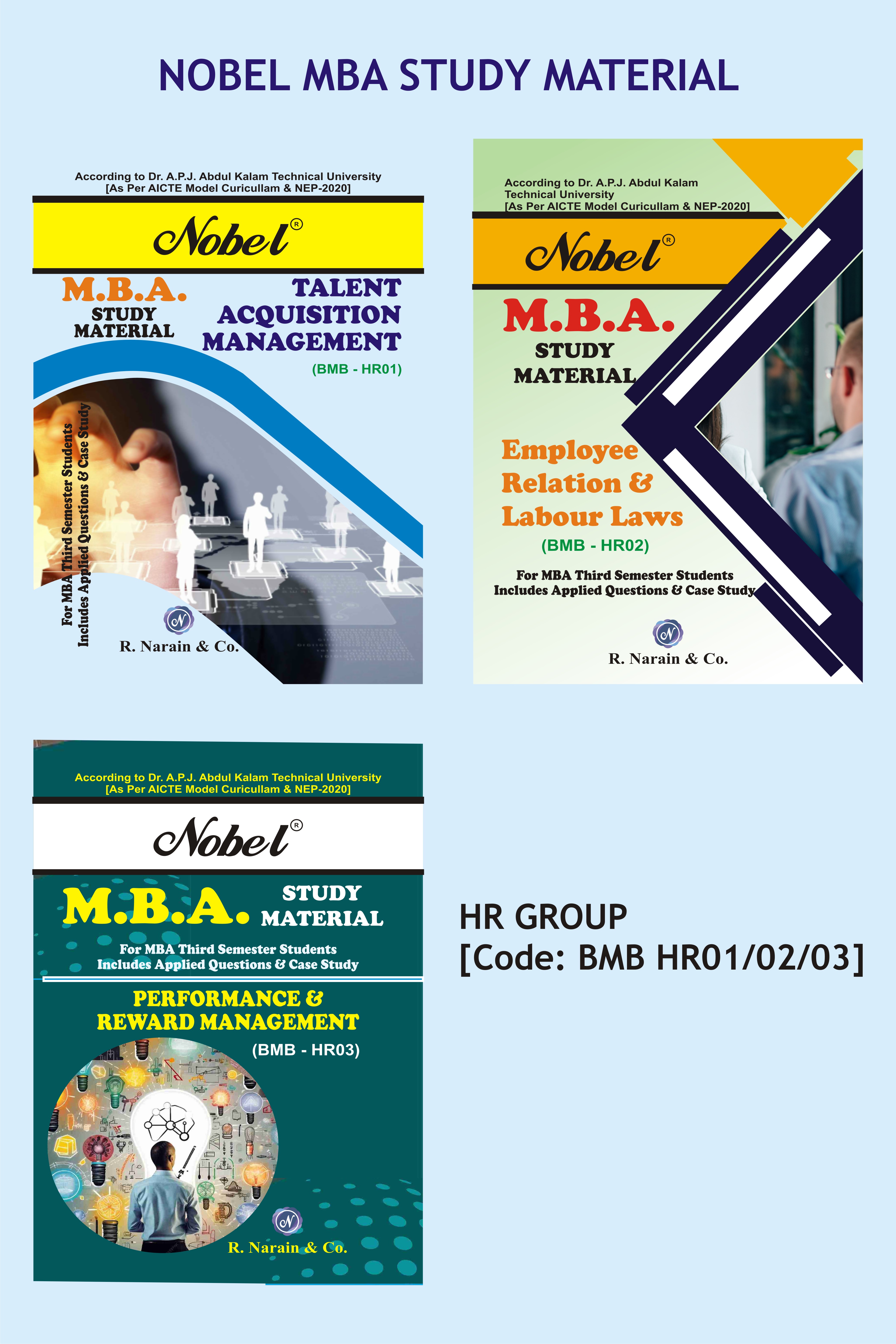
TALENT ACQUISITION & MANAGEMENT (BMB HR 01)
Unit 1: Introduction to Talent Management Concept and evolution of Talent Management; Talent Value Chain: Acquisition, Retention, & Development; Talent Management Models (Zinger Model, Six Principles of TM); Talent Practices: India, USA, Europe, other Asian countries; Strategic relevance of talent for competitive advantage; Cases and latest updates.
Unit 2: Talent Acquisition & Retention Strategies: Talent Acquisition lifecycle: Job analysis, sourcing, assessment; Use of Psychometric tools in recruitment; Best practices in recruitment of various MNCs; Employer Branding and Employee Value Proposition (EVP); Employee Engagement & Retention Strategies; Cases and EVP design exercise.
Unit 3: Talent Development for Global Leadership :Talent develop-ment methods: Coaching, Mentoring, Training; Global Leadership Competencies (GLOBE study, case analysis); Integrated Talent Management Process Succession Planning and Career Development; Use of Meta-Analysis & Talent Analytics; Cases on succession planning; Exercises on leadership assessment.
Unit 4: Performance Management & Rewards:Performance Appraisal Systems (MBO, 360-degree feedback); Compensation and Reward Strategies; Motivating Star Employees and High Potentials; Cultural aspects in talent mobility; Coaching with Compassion (Daniel Goleman framework); Cases on the evaluation of reward policies with latest updates; Exercises on performance reviews and rewards mapping.
Unit 5: Strategic Talent Management & Contemporary Issues: Strategic Workforce Planning; Talent Success Drivers & Talent-Powered Organizations; Big Data, AI & Talent Analytics; Talent Management Challenges; Ethical considerations & Future of Work (employment-to-consultation shifts); Cases and latest updates; Exercises on the talent strategy design using analytics.
EMPLOYEE RELATIONS AND LABOR LAWS (BMB HR 02)
Unit 1: Employee Relations Management (ERM) & Industrial Relation: Introduction and Importance of Employee Relations, Employee Relations Management Tools, Approaches to Understand IR, the Trends of Industrial Relations in India, Factors Leading the Present State of Industrial Relations, Impact of Globalization on the Liberalized Economy. Emerging challenges of IR in India, Linking Industrial Relations with economic growth of a country, Trade Unionism: Development of trade unionism, functions, type and structure of trade union, Why Employees Join Trade Unions , Trade Unions in the Eyes of the Management, Politics and Trade Unions, Outside Leadership of Trade Unions problems & suggestive remedial measures of trade unions, The Trade Unions Act 1926 & Amendment Bill, 2019 : Objective, Recognition and registration, Industrial Democracy & Participative Management. Case Studies
Unit2: Collective Bargaining: Significance, types & procedure of Collective bargaining Discipline: The Industrial Employment (Standing Orders) Act 1961, Misconduct, Disciplinary Action, Types of Punishments, Code of Discipline, Domestic Enquiry, Grievance Handling in IR: Grievance Settlement Procedure, Industrial Disputes, Preventive & Settlement Machinery in India. Employee Participation and Empowerment: Objectives, Employee Participation , Advantages of Employee Participation, Employee Participation in India, Methods of Participation, Employee Empowerment. Case Studies.
Unit 3 : The Factories Act, 1948 & The Factories (Amendment) Bill, 2016 & The shop & Establishment Act 1948, The Payment of Wages Act, 1936 and amendment in 2020, The Workmen’s Compensation Act, 1923, The Industrial Disputes Act, 1947.
Unit 4 : The Payment of Minimum wages act 1948 & its revisions 2019, 2020 & 2021, The Contract Labor (Abolition & regulative) act The ESI Act, 1948 and latest amendments, Child Labour (Prohibition & Regulation) Act, 1986 and its latest amendment.
Unit 5 : The payment of Bonus Act, 1965 and amendments, The payment of Gratuity Cat, 1972 and its amendment 2018, The Maternity Benefit Act, 1961 and amendments, Employee’s Provident Fund & & Miscellaneous Provisions Act, 1952 .
PERFORMANCE & REWARD MANAGEMENT (BMB HR 03)
Unit1: Introduction to Performance Management System: Meaning, Uses and purpose of Performance Management, Performance Management vs Performance Appraisal, Performance management and its challenges in current scenario, Performance management as a System and Process, Establishing Performance Criterion of developing an Effective Appraisal System, Criteria (KRA, KSA VS KPI). Case Studies.
Unit2: Managing Performance: Methods of managing performance of all the levels of Management, 360 degree Performance Appraisal, MBO and Performance analysis for Individual and organizational development. Case Studies.
Unit3: Contemporary Issues: Potential appraisal, Competency mapping & its linkage with Career Development and Succession planning, Balance score card: Introduction and Applications, Advantages and limitations. Case Studies.
Unit 4: Reward System: Compensation- Definition, Function, and significance. Job evaluation: Methods of job evaluation, Inputs to job evaluation, Practical implication for technical/non-technical and executive/managerial positions and significance of wage differentials. Case Studies.
Unit 5: Compensation: Method of pay and Allowances, Pay structure: Basic Pay, DA, HRA, Gross Pay, Take home pay etc. Incentive schemes; Methods of payment: Time and piece rate. Fringe benefits & other allowances: Overtime, City compensatory, Travelling etc. Regulatory compliance: Introductions, Wage and Pay commissions, Overview of minimum wages Act- 1948 and Equal Remuneration Act-1976. Profit Sharing options; Case Studies.